
 1 hour ago
12
1 hour ago
12
The Archive of the Ministry of Foreign Affairs constitutes the institutional memory of Greece’s foreign policy. Through its ongoing classification and digitization, it is being transformed into a modern and effective tool for conducting diplomacy. On Monday, April 20, the digitization project of the Diplomatic and Historical Archive was officially presented at an event held at the Ministry of Foreign Affairs.
Addressing the event, Minister of Foreign Affairs, George Gerapetritis, emphasized that “the digitization of more than 31 million pages of valuable archival material marks a particularly significant step toward transparency. Historical accountability must be grounded in evidence, and that evidence must be objective. Everyone is entitled to their own subjective judgment; historians, researchers, scholars, politicians. On the other hand, the objective records that constitute our history are those upon which any evaluation and any form of accountability must be built”.
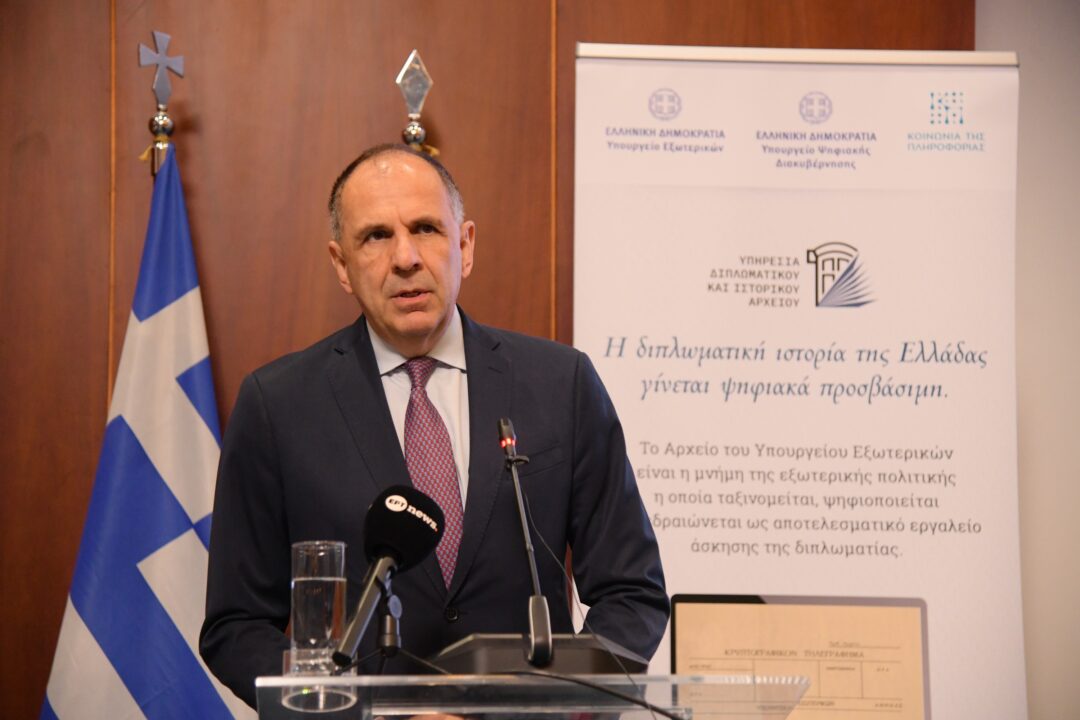
He further emphasized that the digitization of the Ministry of Foreign Affairs’ archive also “serves as a foundation for shaping future policy. Historical memory is what truly forms the conditions for a successful future. No one has ever built successfully without building upon the past, not only on its great moments, but primarily on its failures. Because evaluating each failure is the path to avoiding it in the future. For this reason, the digitization of the archival material of the Ministry of Foreign Affairs essentially represents the path through which we will ensure even greater and more significant moments in the history of Greek diplomacy.
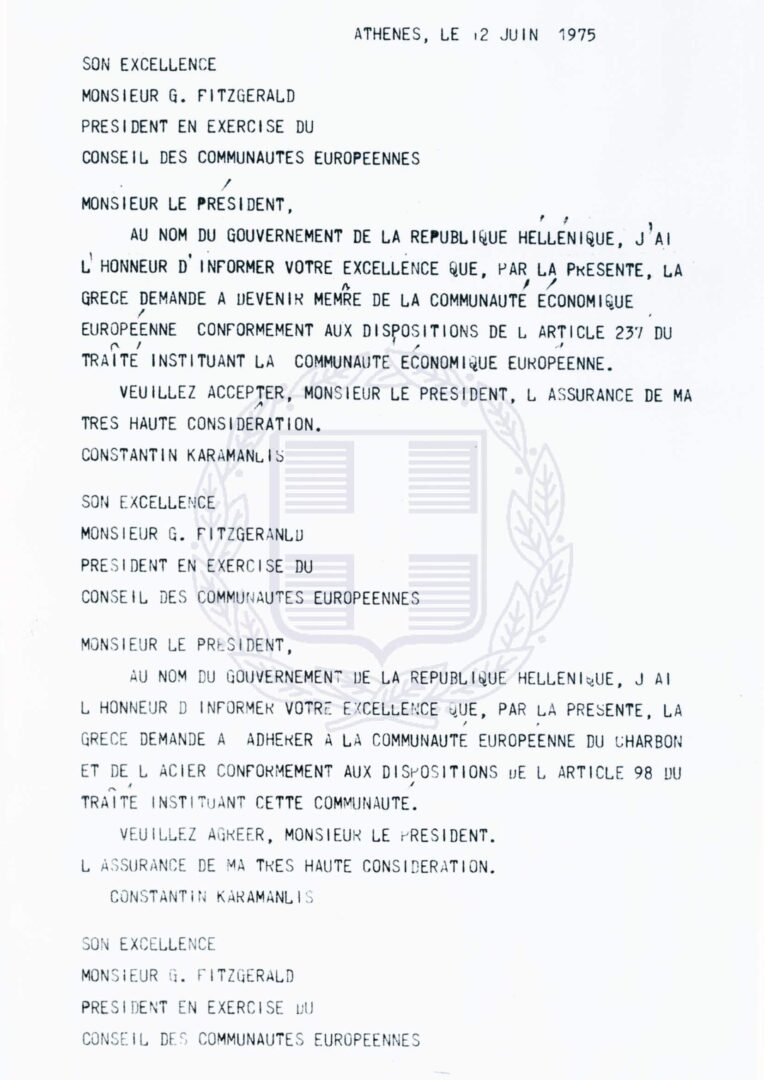 The applications of Greece for membership of the three European Communities (Service of Diplomatic and Historical Archives, Archives of the Embassy in Rome 1975, File 5.1)
The project was implemented within the framework of the National Recovery and Resilience Plan “Greece 2.0,” funded by the European Union – NextGenerationEU, in cooperation with the Information Society S.A., with a consortium comprising OTE and QUALITY AND RELIABILITY S.A. as contractor. The project was completed over 8 months, with contributions from more than 150 employees from both the contractor and the Ministry of Foreign Affairs.
Within this framework, tens of millions of pages of archival material were digitized and microfilmed. Furthermore, tens of thousands of previously unclassified archival folders were organized and a new digital platform was developed to allow licensed researchers to access and study the digitized archival material (including the use of Artificial Intelligence tools).
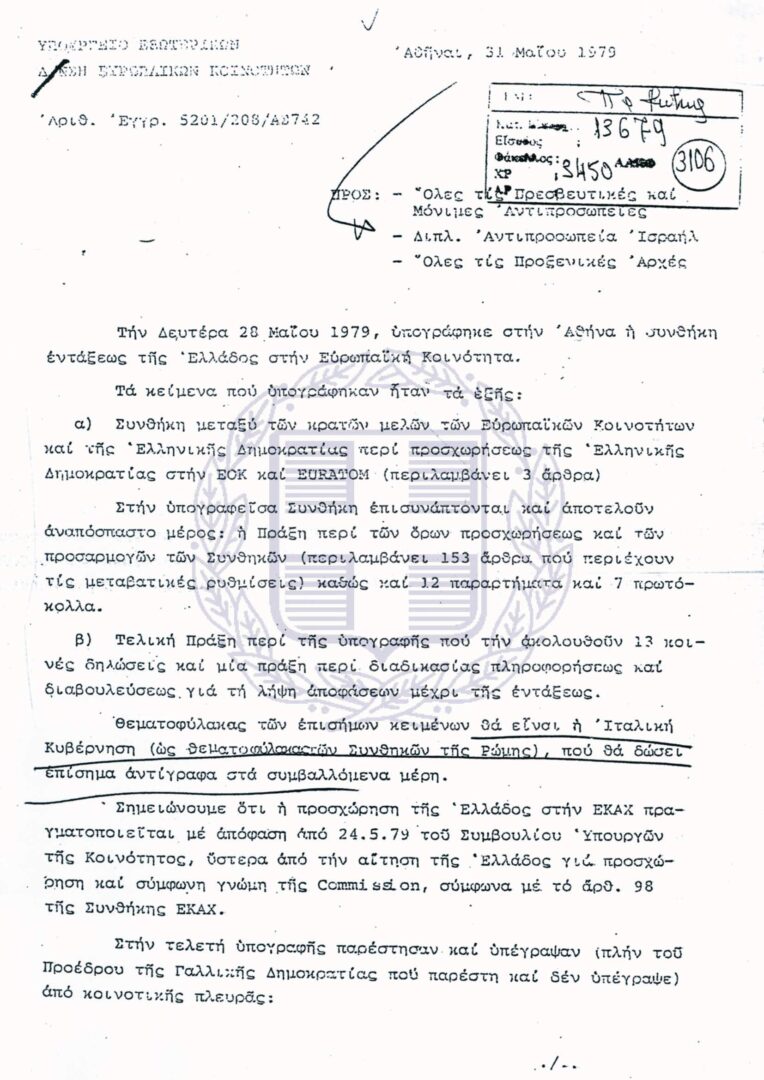 On May 28th 1979 the Treaty of Accession of Greece to the European Communities was signed at the Zappeion Megaron in Athens. The European Communities Directorate of the Greek Ministry of Foreign Affairs officially informs the Greek diplomatic and consular authorities abroad on the signing of the Treaty (Service of Diplomatic and Historical Archives, Archives of the Embassy in Rome 1979, File 3450)
Benefits of the project
Through digitization, the archival material of the Ministry of Foreign Affairs is integrated into a comprehensive digital infrastructure ensuring secure preservation, efficient searchability, and controlled accessibility, in accordance with the applicable regulatory framework.
In particular, the project delivers the following:
- Expanded archival availability: A substantial volume of previously unclassified or unstructured material has been organized and incorporated into a unified system, making the archive more complete, coherent, and clearly defined.
- Sustainable preservation: The material is now stored in digital form within a secure environment that ensures data integrity, enhanced protection, and long-term preservation.
- Enhanced safeguarding: All digitized material has also been microfilmed, providing an additional analog backup layer.
- Immediate access through AI tools: Advanced mechanisms for information retrieval have been developed, enabling fast and efficient access under strict management rules and modern standards of security and confidentiality.
- Improved usability: The archive is now significantly more accessible and functional for researchers, citizens, and policymakers, supporting foreign policy through quicker access to reliable data and well-documented references.
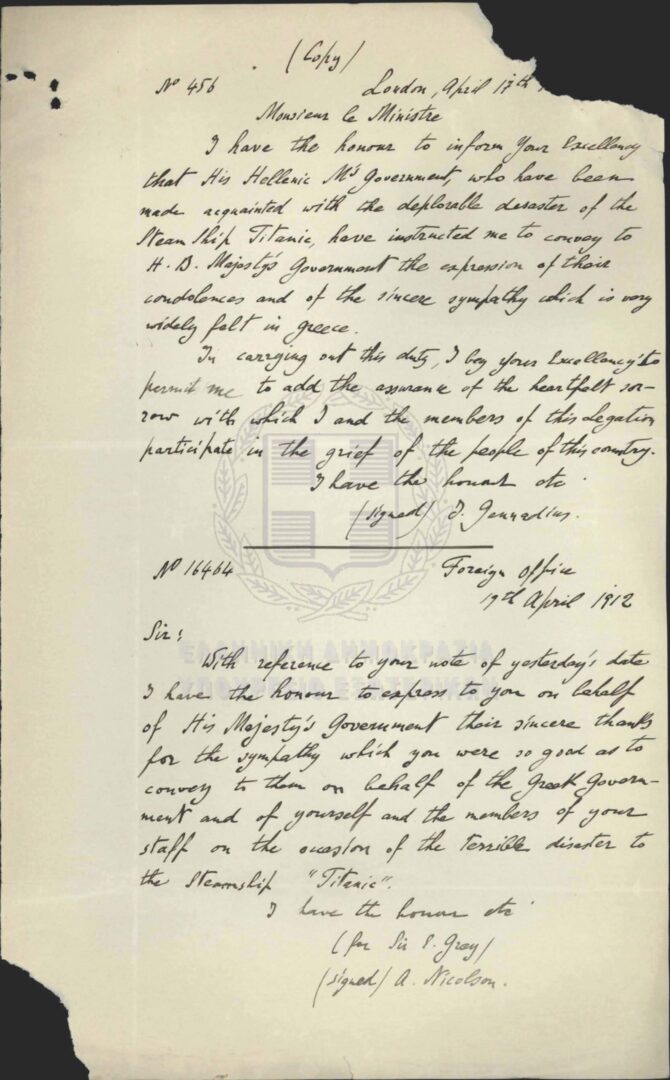 Copy of the letter of condolences dispatched by the Greek Ambassador in London I. Gennadios to the British government on the sinking of the Titanic, and the reply of the Foreign Office (Service of Diplomatic and Historical Archives, Central Service Archives 1912, File 56.6, p.4)
Strengthening the Archive as a Tool of Diplomacy
The digitization of the Diplomatic and Historical Archive significantly enhances the use of documented historical knowledge as a structured instrument for international communication and diplomacy. Through controlled access and reliable retrieval systems, the Ministry of Foreign Affairs strengthens its ability to support the consistent presentation of Greek positions and to facilitate a deeper understanding of key historical and political decisions.
In this way, the Archive evolves into a hub of documentation, outreach, and transparency—contributing to democratic accountability and reinforcing the credibility of Greece’s international presence.
A European Benchmark in Diplomatic Archive Digitization
This project establishes Greece as a leading country in modern archival management at the European level. For the first time, such an extensive and historically valuable body of material has been systematically organized, documented, and made operational through a unified digital infrastructure with high standards of security and institutional oversight.
Rather than merely aligning with international practices, this initiative sets a new benchmark for preserving diplomatic heritage and leveraging it effectively in support of national priorities within the global environment.
Diplomatic and Historical Archives
The Service of Diplomatic and Historical Archives (YDIA) of the Hellenic Ministry of Foreign Affairs (MFA) is responsible, according to article 142 of the Statute of the Ministry (Law 4781/2021), for organizing, preserving, safe-keeping, utilizing and promoting the archives of the Ministry of Foreign Affairs, for issuing studies, for the declassification of diplomatic archives and the encouragement of research. It is responsible for all records containing information (archives) that the Central Service of the Ministry (Directorates, Services, Offices) and the Greek authorities abroad (Embassies, Consulates, Permanent Delegations, Liaison Offices) receive, create or send, in all formats (ex. documents, audiovisual items, electronic records etc.). YDIA is also responsible for the Audiovisual Archives, the Library and the museum collection of the Ministry.





 Greek (GR) ·
  English (US) ·